Sunday, May 29, 2011

ZANZIBAR

Words. I must’ve lost them in the maze.


Near the docks.

The calling of the ocean. 


Houses and homes.

The view above.


Street lanes.

The enchanting labyrinth.


Pharmacy.

The pleasant oddities. 


Fish auction.

The hustle and bustle. 


Elephant door.

The treasure trove of beauty. 


Tipu Tip's House.

The story of the past. 


Forodhani Park. 

The epitome of youth.


Echo Beach, East Coast.

The greetings of the sun. 


Ladies at the market.

The kaleidoscope of life.

Tuesday, May 10, 2011

DR. LIVINGSTONE, I PRESUME?

The now famous words supposedly uttered by H.M. Stanley when he finally found David Livingstone in Ujiji, Tanzania, after the latter had been out of contact with the Western world for many years. The year was 1871. David Livingstone was the first European to explore the Zambezi within the Livingstone vicinity. Now, Livingstone is a thriving tourist town in Zambia, where the Victoria Falls draw thousands of holidaymakers and dreamers from around the globe. 


Livingstone was where we’d be staying for 2 weeks.


Town of Livingstone.

Livingstone.


Crossing the border of Botswana into Zambia via Kazungula was a pleasant breeze. Holding a Malaysian passport, all I had to do was fill up a simple form which recorded the list of foreigners entering the country. It’s more like a guest list and the officers were polite throughout. I wonder now what would’ve been playing in their minds and I’m reminded again of that historical encounter between Mr. Stanley and Mr. Livingstone, the reply back to Mr. Stanley was, “Yes, and I feel thankful that I am here to welcome you.“ Wouldn’t that be a novelty.


Kazangula, the border town of Botswana and Zambia.

Kazungula.


The ferry should’ve cost us 2 Pulas each but nobody went around to ask for a fee. Kazungula is 60km from Livingstone and a group of cabbies wait outside the gate to take you to town. The normal rate is 150,000 Kwacha (USD30). We shared a taxi with Renee, whom we met and was coincidently staying at Jollyboys Camp that was earlier recommended by Lucky. Unfortunately it was full for the evening due to the Easter weekend so we stayed at the Comfort Inn in town. The owner was very friendly and the room was cheap but decent; a house converted into a guesthouse.


I have many good things to say about Jollyboys Camp. Although it’s a 15-minute walk from town compared to Jollyboys Hostel, it’s worth every penny you pay for the dorm rooms. At USD10/person/night, it’s very peaceful; it has clean ablution blocks, a kitchen, an amazing lounge area and restaurant where we caught a few minutes of the Royal Wedding, an internet cafe, a shop, a camp site, a swimming pool, a braai area, dorm blocks, individual rooms/cabins if you opt for that and best of all the surrounding greenery. Everybody’s friendly, from the front desk staff right to the maintenance staff. Highly, highly recommended. Our base in Livingstone established, we interacted and worked with the Kwenuha Women’s Centre, the Lubasi Home and the Youth Community Training Centre (YCTC).


The dorms in Jollyboys Camp.  The individual cabin.

Jollyboys Camp, not to be confused with Jollyboys Hostel in town.  Kitchen, lounge, restaurant.

The Jollyboys Camp in Livingstone, south of Zambia.


KWC

 The good people at the Kwenuha Women’s Centre, one of the organizations we interacted with in Livingstone.


The one last splurge for us in Livingstone was to walk the cheetahs at the Mukuni Big 5 Safari. Cheesy as it sounds, I don’t think I’d ever relive the experience anytime soon and it was nothing short of extraordinary. The cheetah walks are USD85/person, you can get a good deal if you combine it with either the lion walk or elephant ride. I was thrilled just to have a chance to see a white lion cub.


Keeping up with the cats.

A quick rest.

A few words of encouragement from Rizwan.  Cheetahs purr like engines.

  Walking the cheetahs at the Mukuni Big 5 Safari.


The luxurious Mazhandu buses from Livingstone to Lusaka run once daily, with tickets at 85,000 Kwacha/person (USD20) and leave at 9 a.m. They’re very comfortable and spacious but one tip is to try to secure a seat on the right side of the bus, anywhere along the row behind the driver. This is to avoid the scorching afternoon sun on the left. The music selection was pretty chaotic yet entertaining just for that fact – anything from Michael Jackson to Hong Kong ballads.


We stayed at the Kuomboka Backpackers, which turned out to be a good thing as it was less crowded compared to the Chachacha, the most famous hostel around, where we originally planned to spend the night. The Chachacha seemed to be full of western tourists who managed to arrive with or form their own cliques, and foreigners filling up the bar to its brim. The Kuomboka Backpackers was much more relaxed, frequented by both locals and foreigners alike and priced at 150,000 Kwacha/night (USD30) for a double room.


In Lusaka, we had the pleasure of being hosted by Topsy who showed us around town. We tucked into nshima served with a healthy variety of meat, fish and vegetables for lunch, leaving almost no room on our table. The evening before we feasted on grilled goat at the Kalahari Restaurant and were entertained by the local crowd, dancing the night away while the band played.


Lunch in Lusaka.

Nshima and various dishes with Topsy.


Thinking back, there are several things I love most about Zambia: -


1. It’s a super friendly country; in fact it’s the friendliest I’ve come across in this journey. Everyone in the street will say hello or smile at you, and even the seemingly grumpiest looking person will respond when you initiate the greeting.

2. All the lovely bright and multi-coloured print sarongs the women wear. It just feels festive everyday. They are not afraid of prettying themselves in fuchsia or sparkly maroon, with occasional splashes of lime or indigo on top of that. The colour mix is haphazard enough to make for an interesting conversation. It’s advisable to have your sunglasses in hand, especially for you faint-hearted ones.

3. Old style hand-painted advertisements adorning the street walls. It’s quite rare to find printed ones around. The practice is still very much alive and well. I can imagine how much more satisfying it is too, a finished piece of work displaying a dying skill. It’s far from being menial.

4. It’s the only country I know so far where the 24-hour system is used. Zambians get confused when you tell them you want to meet them at 2 o’clock in the afternoon. You’re supposed to say 14 hours. 9 in the morning is 9 hours.

5. The little unusual but mostly amusing things you encounter when you least expect it. Chinese ballads being played during bus rides when there’s remotely any Chinese. Then there were attendants coming around to announce which flight is boarding as the the boarding halls are not numbered – gives a whole new meaning to international airports.


All of Zambia’s openness, warmth and simplicities make me smile.

Tuesday, April 26, 2011

THE SMOKE THAT THUNDERS

The first glimpse of the mighty Victoria Falls makes your head spin.


The Victoria Falls


You feel genuine fear reaching from the deepest pit in your belly snaking its way through to the finest veins in your legs, your arms, the core of you until you climax in a burst of awe. Numbness follows. You cling to the handrails, you plant your feet firmly to the stone path, you grab anybody next to you; because you’re jelly.


Congratulations, you’ve just been hit by the giant. All 1,708m by 108m of it. But it hasn’t even touched you. Not physically. Not even close.


Until you gather the courage to cross the puny metal bridge because you HAVE to get a closer look, however unconvincing the structure feels. That’s when monsoon strikes. And yet, that’s not the full force of the giant’s power, just a tease.


Soaking wet crossing the bridge, the soles of my shoes came off too.

Have you ever seen anybody more happy to be caught in torrential rain? Crossing the Knife Edge Bridge in Victoria Falls. A waterproof camera is essential.


Then you discover that the giant has a softer side. It plays with the sun and dances in the mist and lo and behold, the giant creates not one, but two rainbows, with glee.


Twin rainbows.

Twin rainbows by the waterfall. We also saw a full semi-circle that goes UNDER the bridge. In moonlight, you’ll see ‘moonbows’.


Victoria Falls Bridge.

The 1.3km Victoria Falls Bridge; the border of Zambia and Zimbabwe, and the bungee jumping station right smack in the middle.


The rainforest embraces the nurture of the giant, as the rocky dry land too far from reach, sits and watches, hopelessly forlorn, barren.


The rainforest.

The rainforest.


Barren land just on the opposite side of the falls.

And the dry half of the land, within the same vicinity of the falls.  


They call it Mosi-o-tunya, the Smoke That Thunders. And rightly so.


Sprays up to 400m in height and can be seen up to 50km away.

 The annual flood season runs from February to May, peaking in April. The spray of the falls rises to a height of over 400m, creating an inverted rain at the Knife Edge Bridge.


 Upstream of the falls.

It’s too dangerous to white water raft in the Zambezi River this season. I have to say, I was a bit disappointed as I was looking forward to it.


This is mother nature’s great wonder. The experience hard to fathom. The giant never forgotten.


Another great day. The entrance fee to the falls is USD20.

Monday, April 25, 2011

PHOTO ALBUMS (SOUTH AFRICA & BOTSWANA)

To view the photo albums, please click on the respective photos or links below: -


South Africa

The SOUTH AFRICA Album


Botswana

The BOTSWANA Album


Have fun!

Sunday, April 24, 2011

A MILLION DRAGONFLIES

Fact: Finding yourself in Botswana and not taking your chance on the wild side


….Is.

….A.

….SIN.


Simply because Botswana has more than enough to offer (all you nature buffs everywhere, hear ye, hear ye!). Throughout our travel in Botswana, we encountered the desert, inland delta, salt pan; apart from being turned into farmlands, most are now nature reserves. Tourism is BIG, it’s a pity that promotion is lacking – there wasn’t even a proper tourist info desk at the international airport, nor a brochure in site. To be fair, it is a newly built airport but if car rental and cab services are available, and to help the serious ‘go-with-the-flow’ tourists arriving without having done any homework on their destination of interest beforehand, you would think it would’ve made sense for them to start at the airport. Unless ‘take me to town’ suffices. I’m probably too particular in that sense. Cab drivers can smell your cluelessness miles away, and you’re screwed. What if Mr. Cabbie just arrived from a foreign land too? (That happened to me before, I had to explain the directions to the cab driver)


Botswana overland route

Botswana’s the first country where we travelled overland throughout - from Gaborone to Ghanzi to Maun to Kasane via Nata before crossing the border to Zambia via the Kazangula border.


So, after spending a few nights at the San lodge, we took the 3.5 hour bus ride from Ghanzi to Maun costing 52 Pula/person (USD8). Street sellers will actually pile up into the bus to sell newspapers, munchies and bananas, even socks (!) for the journey but strangely not drinking water. Looking through the glass windows from the outside before you board, it’ll look like the bus is jam-packed but there’re probably a few vacant seats left so you have to be quick. As soon as the bus fills up, it’ll leave.


The folks at Dqae Qare (still no luck in pronouncing it correctly) recommended the Okavango River Lodge; that’s where we were headed to (by the way, internet connection around Africa has been at best, sporadic, and generally slow). The minute we walked into the spacious room, we knew it was a win. We got lucky because it’s a 3-bed dorm (such an odd number, the 3rd person must’ve felt like a lamp post the whole time if the other two travelled together) but the 3rd guest didn’t show up so we had it all to ourselves, with an attached bathroom; all for 90 Pula/person/night (USD14). The food and beverages were also reasonably priced, the portions value for money. We signed up for the mokoro (traditional dug-out boat) ride for the next day, into the Okavango Delta, at 600 Pula/person (USD92), hoping that the rain wouldn’t fail us - again. It seemed that the gray clouds had been tagging along with us everywhere.


 The lodge is located right by the river, you'll have dinner while enjoying a natural orchestra of frogs and crickets....and occasionally the determined mosquitos.    Clean, comfortable, a bargain at 90 Pula / person / night.

The Okavango River Lodge in Maun.


A speed boat will take you to the Boro Station (we got a slightly hungover driver but luckily yours truly survived in one piece) where you’ll hire a poler for your mokoro and he’ll also be your guide for the day. On the way to the jetty you’ll enjoy an array of beautiful birds and small wildlife, the largest being the crocodiles. Our poler was a nice chap called Lenkamile. As you enter the delta, there’ll be less birds and wildlife and you’ll be surrounded by nothing else but reeds and water lilies. The best part of all -the sheer peace and quietness encapsulating you as you go – nothing but the soft ‘woosh’ of the pole slicing through the clear waters. About an hour later, we were walking on one of the ‘islands’ – I have to say, toilet paper saved me from the grief I would’ve faced being in the bush with the least vegetation! Girls, take note! It wasn’t a successful walk, we only stumbled upon an old lone elephant and a curious lone antelope checking us out from yonder….well, hippo bubbles too, if you count that in.


We later learned that the polers only get a fraction of what’s being charged by tour operators. Not so much of a surprise because due to the location and accessibility, tourists only get a chance to communicate with the operators first before being aware of any possible arrangements directly with the polers. Another advice is when bringing snacks or lunch for the trip, do consider including some for your poler because most of the time it’s not included in the rates charged to you. Lenkamile offered us overnight stays at his village and camping trips the next time we visit; we’re definitely considering it!


 Reflections of the clouds in the water makes you forget.

 Crisscrossing through the Delta. The most serene and peaceful environment in Africa I’ve experienced so far. 


Getting tanner by the minute!

Rizwan on a game walk in the Delta.


Boro hut.

A house at the Boro Village. Quite geniusly constructed from natural resources, and tin cans used to strengthen the structure.


We spent the last night at the Okavango having to iron our damp clothes to make sure they’re dry by the next morning.


The clothes were as damp the next day.


Warning: Dry Fits don’t work in this territory.


From Maun we took the bus to Kasane. The only hassle was that we had to transit in Nata and there’s no guarantee that there’d be buses from there up to Kasane. In Nata, we were dropped off at the local gas station and were told to wait for the buses coming from Francistown. The buses stopped alright, except for the fact that they look more like mini(sardine)vans. 


We hitch-hiked for the first time.


And what a ride it was. The driver was driving at 150km/h on the tarred road and 130km/h on gravel road heavily pot-holed. Lo and behold, the tyre burst AND he was stopped for speeding – nothing a couple of hundred Pulas can’t settle….after an hour of negotiating that is. The highlight of the ride was when we encountered an elephant standing happily in the middle of the road. We were indeed now, trespassers on his land. A magnificent sight nonetheless.


We met up with Lucky in Kasane whom we’d be hanging out with for the next few days. We went on a sunset cruise on the flooded Chobe River that evening and saw hippos up close. It became a bit nerve wrecking when we realized they were so many of them everywhere. They’re dangerously sneaky huge blobs of dark gray in the water!


Never mess with these guys!

The closest we got to a hippo was when we discovered one chilling out just near our camp.


Mom and babies. 

Baby elephants playing with each other while having a quick drink with their mother.


The next couple of nights we camped out, under the stars, first at the Chobe Safari Lodge then in Chobe National Park. It was an incredible experience. Every night, we’d just gaze up at the belt of stars, imagining it as a whole galaxy above us until our necks hurt – so brilliant and beyond compare.


If you ask me, I prefer the game drives in Chobe better than Pilanesburg in South Africa. In Pilanesburg you cover so much ground but the animals you see are merely tiny specks in the distance. Driving in Chobe is like driving in a zoo - everything’s life size. And lions, we finally saw lions (!) – a whole pride, resting under a tree after probably a healthy meal the evening before.


    An adult male giraffe.    Your friendly neighbourhood vultures.

    A buffulo not minding the company.

Some of the animals up close in Chobe.


A camp is never complete without a barbeque so a braai was well on its way for dinner in Chobe.


 Setting up camp.    Sunset gold from our camp.

Our camp site in Chobe.


We said goodbye to Botswana after 2 weeks of adventure and made our way towards the ferry to cross the border to Zambia. It wasn’t a full accomplishment, we missed the Central Kalahari Game Reserve and the Makgadikgadi Pan. Bust next time when we’re back, it’ll be proper 4-wheel drive with roof camp and kitchen – the way they do it here, hard core Safari style.


Now if you don’t mind, Mr. Cab Driver, take me to the nearest Sports Toto. In this country, please.
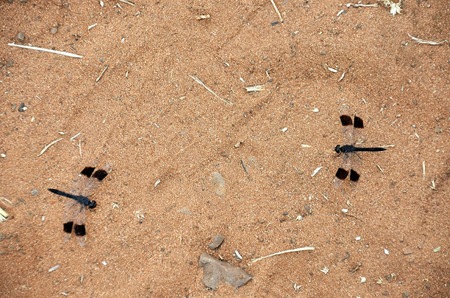
 

The spots on the wings of the dragonflies, like brown velvet.

Dragonfly season. And the end of our journey in Botswana.

Tuesday, April 19, 2011

A WALK IN THE BUSH

Dqae Qare.


Can you say it?


After a week working in Gaborone we decided to make the journey to other parts of Botswana, starting with Ghanzi. An 8-hour bus ride from Gaborone to Ghanzi costs just under 130 Pula (USD20), the earliest bus leaves at 6.00 a.m. There were so many donkeys along the bus route, it’s donkey heaven. We didn’t manage to get contacts for Ghanzi so we spent the first night at the Kalahari Arms Hotel, just a 5-minute walk from the bus station. It’s the oldest hotel in Ghanzi but it’s been maintained very well. We finally had the chance to open a bottle of wine for a belated birthday celebration for Rizwan.


The next morning, we were picked up by Komstsa from Dqae Qare, the San (Bushmen) community lodge, 20 km out of Ghanzi, where we decided to stay for a couple of days, hopefully to learn about the San community. Dqae Qare is owned by and taken care by the San community. Over the years, the San community has been forcedly displaced from their lands and relocated into different grouped settlements when their lands were taken over by the Bantu people and the whites. With it they were forced to change their way of life. Originally hunter gatherers, they had to adapt to unfamiliar systems like money. They were given cattle as compensation but not the skills or knowledge in managing cattle. The cattle then either escape into the wild or get eaten by lions. Since then so many of their original skills are lost too because nobody practise them anymore and they’re not handed down to the next generation. Their culture is dying slowly. Sadly, the younger generation are also ashamed of their roots and choose life in bigger towns and cities. The last San village was removed by the government from the Central Kalahari Game Reserve (CKGR).


Komstsa is from the Dcui tribe and speaks Naro. I had so much difficulty pronouncing the combination of consonants and clicks AND vowels. The tribes come from different locations and speak different languages. What I noticed about the San, or at least the ones I met, is that they have softer face features, their skin a gentle chocolate brown instead of coffee black.


Wildebeests, kudus and ostriches roam your front porch freely here. The water is slightly salty but drinkable. Similar to South Africa, you can drink the water straight from the tap in Botswana. The sand has a reddish tinge instead of the normal light brown. It was another win, we were the only ones there, in the bush.


On the way to Dqae Qare.

Komstsa (right) accompanied here by Shadreck driving us to Dqae Qare.


The view from the side of the lodge.

The establishment is not big but consists of one main accommodation block, a few ‘traditional’ San huts, a camping ground, a kitchen and a rest area where food is normally served. There is also a dance arena and lookout tower. Breakfast and dinner are included in the rates, so it’s a good idea to bring your own supply for lunch.


The huts.

There are comfortable beds inside the San huts at the lodge, it is merely an experience but not as real. On the left is the ablution block.


   DSC_0347A   DSC_0392A

San art and the full moon at night.


We went on a bush walk the morning after. We learned a bit about the plants used by the San to be consumed or to be used to heal ailments. Nowadays, the San still gather nuts and berries, their favourite is the brandybush berries, naturally sweet and used to make traditional alcohol (hence the name). Komstsa also showed us animal tracks on the way to the Tatase pan, where we sat observantly, waiting for the animals to come for a drink.


Bush walk.

Komstsa explaining about one of the plants during our bush walk.


    San child.

A San child.


San ladies. 

The kind ladies at the lodge.


Spending time with them has brought greater understanding of their life, history and ongoing struggles. A few times while listening to Komstsa, I thought to myself, “All of this sound familiar. It’s just like home.”: - How lands are taken and destroyed in the name of development, communities uprooted as a result.

The greatest challenge is how to make sure that all is not lost – the culture, the tradition, the history, the language, the skills…., most of all, the pride and dignity of the people of the land – before it’s too late.


Actual San hut.

This is a present day hut actually occupied by a San family in Dkar, not far from Dqae Qare.


Mission: Read – Tears For My Land by Kuela Kiema

Related Posts Plugin for WordPress, Blogger...